

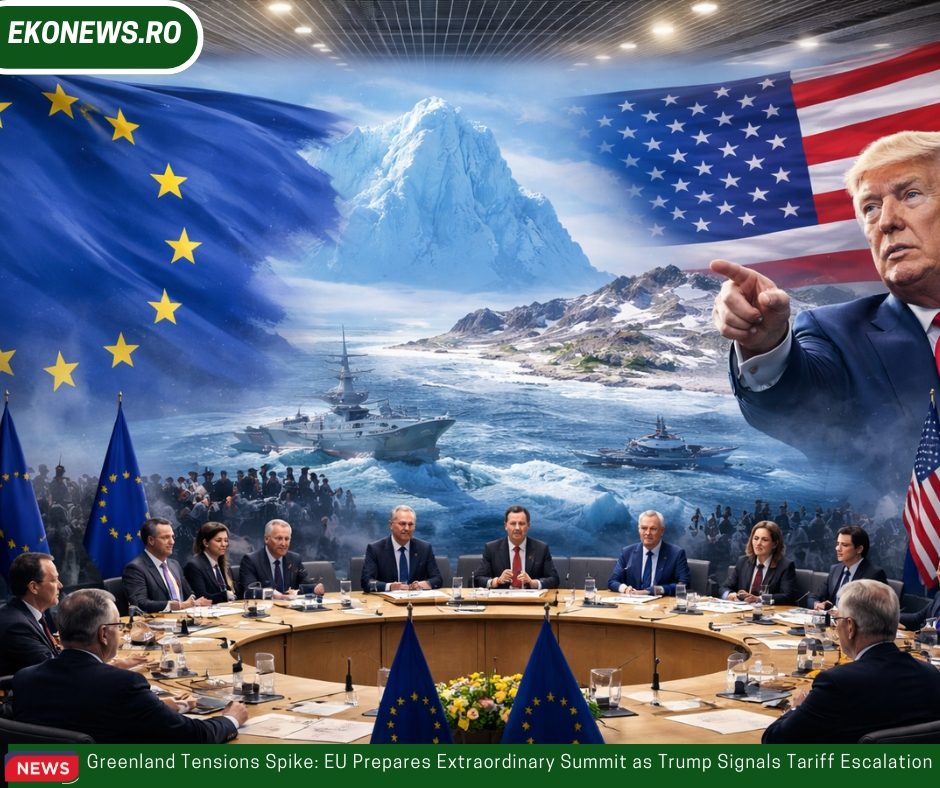
The European Union is facing a fresh surge of transatlantic tension after U.S. President Donald Trump explicitly tied the Greenland issue to the prospect of additional tariffs against several European countries. Brussels moved quickly: EU leaders are preparing an extraordinary summit to lock in a common line at a moment when political pressure is being applied through economic tools. NATO has also been pulled into the spotlight, while EU discussions about a possible trade response are taking clearer shape. The coming days will test how far Europe is prepared to go to deter what many in the bloc see as a risky precedent—one that blends sovereignty questions with market leverage.
Emergency summit in Brussels: the EU aligns its stance on the Greenland file
Calling an extraordinary summit signals that Brussels is treating the episode as more than rhetorical sparring. The EU’s immediate objective is to coordinate a unified response, especially given that Denmark—an EU member state—sits at the center of the dispute, while Greenland remains an autonomous territory within the Kingdom of Denmark.
European Council President Antonio Costa said EU leaders would meet “in the coming days,” with discussions expected in Brussels. In the background, ambassadors from all 27 member states have already begun consultations aimed at narrowing the range of options and defining red lines. Those options span diplomacy, political messaging, and a spectrum of potential economic countermeasures.
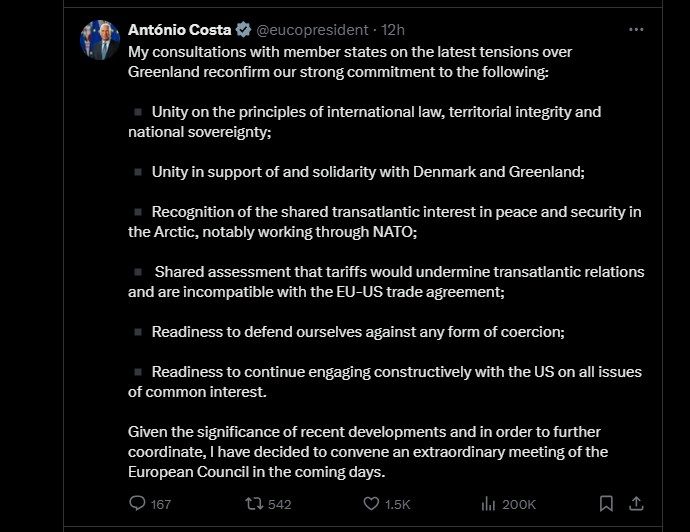
The broader stakes are also strategic. Beyond protecting a member state, the EU is positioning the Greenland dispute within the wider principle of territorial integrity—an issue with particular sensitivity in an increasingly contested Arctic, where security, resources, and infrastructure projects are drawing growing attention.
The tariff threat and the “sale of Greenland” demand: what Washington is pressing for
The core of the crisis lies in the pressure formula associated with Trump: a push for an “agreement” involving the “full and complete sale of Greenland,” paired with escalating trade penalties if there is no outcome. According to accounts carried by international media, the tariff path under discussion would begin with a 10% rate from 1 February, with a possible increase to 25% from 1 June if the White House’s demanded arrangement is not reached.
Notably, the announced targets extend beyond Denmark. They include several allied European countries—Germany, France, the United Kingdom, the Netherlands, Norway, Finland, and Sweden. That wider list matters because it suggests a strategy of broadening pressure across multiple capitals, creating knock-on economic effects that could complicate EU unity and raise the domestic political costs of confrontation.
Greenland, for its part, has repeatedly indicated it does not want to become part of the United States. While the debate often takes place at the level of major powers and grand strategy, Greenland’s local realities—its small population, limited administrative capacity, and strong sensitivity to external decision-making—amplify the political stakes. A forced or transactional outcome would directly challenge the self-determination principle that European leaders frequently cite in external relations.
Economic retaliation on the table: €93 billion in tariffs or restricted single-market access
The EU’s internal debate moved quickly into deterrence logic: if the pressure is economic, the response can be economic too. Two broad options have been discussed in EU consultations. The first would mirror the tariff approach through duties on U.S. imports, reportedly estimated at €93 billion. The second—considered more severe—would involve measures that restrict U.S. companies’ access to parts of the EU single market.
The first route would primarily hit conventional trade flows: goods, supply chains, and sectors where U.S. producers have significant market exposure in Europe. The second would move beyond border tariffs and focus on operational access—how American firms can sell services, compete in regulated segments, or operate within the rules of the EU’s integrated market. Because the EU single market remains one of the world’s most attractive economic spaces, any serious limitations in access would represent a major escalation.
Also present in the background is the EU’s Anti-Coercion Instrument, designed for situations where a third country attempts to force political decisions through economic pressure. In practical terms, the mechanism provides a structured pathway toward targeted countermeasures, typically following assessment, consultations, and efforts to de-escalate. The instrument has been framed by EU institutions as a way to defend the bloc’s sovereign decision-making against coercive trade and investment tactics.
For business, the implications are immediate: this dispute is no longer purely geopolitical. It risks spilling into cost structures, market predictability, and operational planning. For consumers, an escalation of tariffs and counter-tariffs can translate into price pressures and volatility—particularly in sectors with tightly integrated supply chains.
NATO enters the equation: Mark Rutte’s Brussels talks with Denmark and Greenland
While the EU focuses on political coordination and potential economic response tools, NATO is inevitably drawn in through the security arguments surrounding the Arctic and allied defense posture. In that context, NATO Secretary General Mark Rutte has scheduled a meeting in Brussels with representatives from Denmark and Greenland amid the escalating dispute.
Reports indicate that Greenland’s foreign minister Vivian Motzfeldt and Denmark’s defense minister Troels Lund Poulsen are expected at NATO headquarters, with no press conference announced in advance. The meeting underscores the alliance’s interest in preventing a disagreement between allies from turning into a broader strategic fault line.
European officials have also emphasized a key counter-argument: Arctic security can be strengthened through allied cooperation within existing frameworks, without revisiting sovereignty arrangements. In other words, if Washington’s stated rationale is “strategic necessity,” Europe’s preferred answer is “the same necessity—addressed through cooperation and established commitments.”
Scenarios for the coming days: Davos, back-channel talks, and the test of EU unity
The next week features a schedule that could either accelerate the confrontation or open space for de-escalation. The extraordinary EU summit is designed to solidify political alignment and define the bloc’s negotiating posture. At the same time, global forums such as the World Economic Forum in Davos provide informal venues where leaders can probe back-channel options, test messages, and recalibrate public positions without immediately triggering formal commitments.
A controlled de-escalation scenario would likely involve a shift back toward cautious language, potentially separating the Greenland file from trade measures and lowering the temperature on tariff timelines. An escalation scenario would see tariffs take effect, followed by EU countermeasures and possible restrictions, pushing the dispute from politics into the economy—where industrial interests, domestic lobbies, and supply-chain realities make compromises harder and slower.
Internally, the EU is also managing a credibility test. If a territory linked to a member state can be treated as a bargaining chip in trade negotiations, the bloc risks signaling that core principles become negotiable under pressure. That concern is one reason European officials are moving quickly to frame the issue as a matter of sovereignty norms, not merely a transactional dispute.
Long-term implications: the Arctic, resources, and a sharper strategic competition
Regardless of how the immediate dispute evolves, it has the potential to leave lasting strategic effects. The Arctic has become increasingly significant in recent years: new maritime routes, rising interest in resources, expanding military infrastructure, and intensified competition among major powers. In that context, Greenland carries both symbolic and practical weight—as a security asset, an economic interest, and a test case for international governance norms.
For the EU, the crisis could accelerate two broader trends. First, it may strengthen debates about strategic autonomy and the bloc’s capacity to respond in a unified manner to external pressure. Second, it could reshape the EU–U.S. relationship in a domain where cooperation has historically been assumed, forcing a more explicit negotiation of boundaries, tools, and acceptable tactics.
For NATO, the episode raises an institutional question: how does the alliance manage a serious divergence among allies without opening fractures that competitors could exploit? The answer will depend on diplomatic skill, message discipline, and the ability to keep security cooperation insulated from political brinkmanship.
For European public opinion, the Greenland dispute puts a straightforward but uncomfortable issue on the table: when economic power is used to pursue political objectives, who ultimately controls sovereign choices? In the weeks ahead, Europe’s response will be judged not only by whether it deters escalation, but by whether it demonstrates cohesion—and draws credible limits around coercion in relations among allies.
Latest news